Also spelled as Robinson, Robison, Robeson, Roberson and Robertson.
James Robertson was born on June 28, 1742 in Brunswick County, Virginia. He was the son of John and Mary Robertson.
He married Charlotte Reeves on January 17, 1768 in Wake County, North Carolina.
William Blount Robertson,
Jonathan Friar Robertson,
James Robertson, Jr.,
Delilah Robertson Bosley,
Peyton Robertson,
Felix Robertson,
Charlotte Robertson Napier and
Lavinia Robertson Craighead.
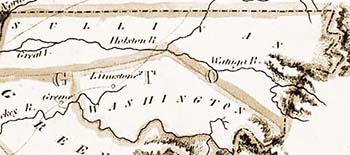
Godspeed's History of Carter County says James Robertson came to Watauga in 1770, and the next year settled beyond the bluff opposite the mouth of Doe River. He remained there until 1779, when he moved to the Cumberland. His brother, Charles Robertson, lived on Sinking Creek.
Rich Creek 15th September 1774
Sir—we are Stop'd a day to Get what Beeves and Catties We Can Pick up.
Capt. woods and his Party is Joynd me Which makes our number of the Whole 55
the Soldiers I had at Mr. Woods Desird Discharges from me which I have given them, though they are willing to Inlist again, if you See Cause.
I have sent you an Acct. of their time Likewise finding their Provisions for the time
Mitchel Clay 51 days on Duty found his own Provisions
Zekil Clay 51 days found his Provisions
David Clay 51 days found Do
Richd. Blankenship 44 days Do
P. S. I must be for Ever Obliged to all my good friends for assisting me in Getting my Compy made up as I thought it was meerely Impossible to do it in the time and I am sure there is not Such an Other Compny for the Quaintyty of men belonging to the Whole Dr. Sir, I wish you Every thing that Would make you happy.
I am your Obedt. Servant
James Robertson
from Historic Sullivan by Oliver Taylor
James Robertson signed the 1777 petition of men living on the north Holston River complaining about the division of Fincastle County. They felt the line was not equitable and the court house was too far away.
In 1778, Thomas Standfield bought 640 acres in what was then, Washington County, Tennessee. The land was on Roaring Fork of Lick Creek. One side of his land was on James Robinson/Robertson's line.
The Cherokeewere indigenous people who lived in the southern Appalachian mountains. European Americans called their towns in eastern Tennessee, the Overhill Towns. The towns included Chota, Tellico and Tanasi.
In 1776, the Cherokee planned to drive settlers out of the Washington District. The settlers were warned and stopped the first attack at Heaton's Station. The second attack was stopped at Fort Watauga. In response to these attacks, the militia burned Tuskegee and Citico.
In 1774 Governor Dunmore declared war against the indignious Americans. The war ended after Virginia's victory in the Battle of Point Pleasant on October 10, 1774.